Call the responsible fire authority first
Do not use a website or security vendor to decide whether a watch is required. Report the impairment through the property’s approved fire-safety and authority process. Obtain the written or documented direction that identifies the affected system, area, start, staffing and duties.
California Fire Code section 901.7 says the fire department and fire code official must be notified immediately when a required fire-protection system is out of service. Where the official requires it, the building must be evacuated or protected by an approved fire watch until the system returns to service. For a City of Los Angeles property, follow LAFD direction for that address. Long Beach Fire Department’s policy adds its own local detail for Long Beach properties.
Map the exact protected area
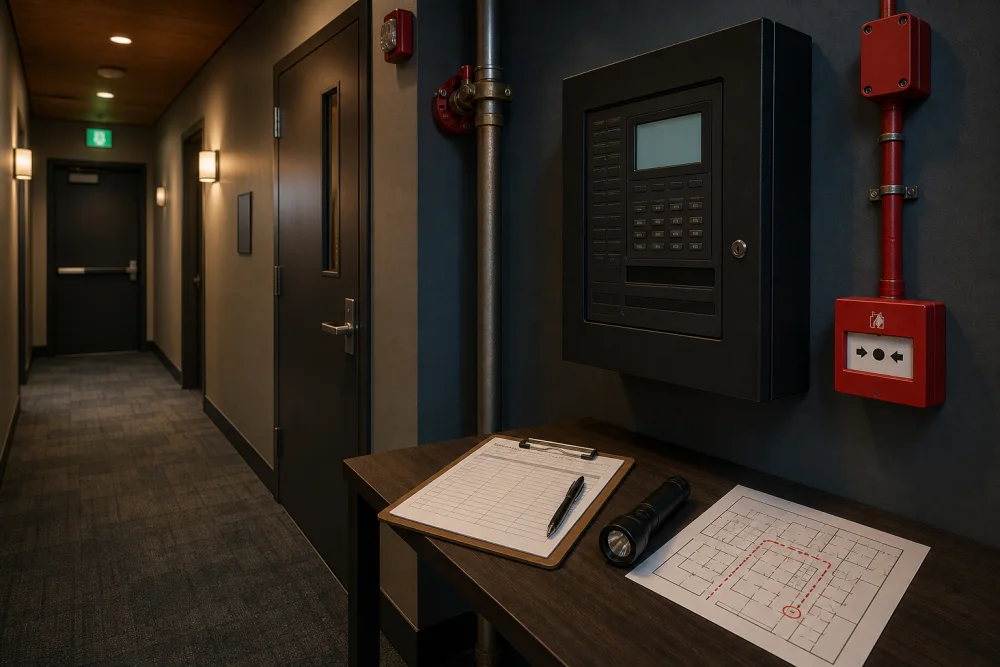
Identify every floor, wing, room, exterior area and route included in the watch. Long Beach’s policy says an order can cover a whole building or a defined floor, wing, atrium, theater, lobby or other significant portion. A site map should show the route, fire equipment, exits, high-hazard areas and communication limits.
The Los Angeles region contains reused Downtown buildings, large industrial sites and harbor facilities. Those site patterns change route length and visibility. Count the real patrol time rather than borrowing a standard round.
Write continuous-patrol duties plainly
State what the watch person observes, how the route is maintained, how occupants are warned and how the fire department is notified. Include the log interval, time source, route record and condition notes required by the authority.
Do not combine access-control, reception or parking duties with the watch unless the authority and written plan allow them without interrupting continuous fire-watch responsibilities.
Provide reliable communication and relief
Confirm the approved method for immediate alarm transmission and site notification. Record backup communication and the address information given during an emergency call. Plan meal, rest and shift relief so the covered area is not left without the required patrol.
Name the on-site contact who receives the log and the system contractor or facility contact handling restoration.
Verify the provider without confusing roles
If a private security provider supplies personnel, verify the legal entity, PPO, insurance and assigned guard registration. Those checks do not make the provider the fire authority, system contractor or code official. The order and property plan still control the fire-watch duty.
Use the PPO and insurance guide and ask the provider to confirm that its proposed personnel will follow the specific order.
Define when the watch may end
The scope should name who can release the fire watch and what restoration evidence is required. Long Beach states that a watch continues until the Fire Chief or designee determines the premises are safe or the equipment or systems are restored to reliable service.
Avoid a purchase order that ends automatically at a guessed time. Add extension rates, supervisor contact and a process for continued coverage if repair is delayed.
Request a quote from the order, not a generic label
Provide the authority direction, property address, covered area, floor count, route, start, expected duration, staffing, relief, communication and log requirements. Ask for regular, overtime, holiday, supervisor and extension rates.
The cost guide explains why a temporary continuous assignment cannot be compared with a short patrol visit. When the authority requirements and site map are ready, Get a Quote.
Frequently asked questions
Who decides whether a fire watch is required?
The responsible fire code official controls the requirement for the property. A private security provider should work from that direction, not replace it.
Can a fire watch guard also cover the lobby?
Only if the authority-approved duties allow it without interrupting the required continuous patrol. Treat extra duties as a question, not an assumption.
When does a fire watch end?
It ends under the responsible authority and restoration process, not simply when a scheduled shift expires.