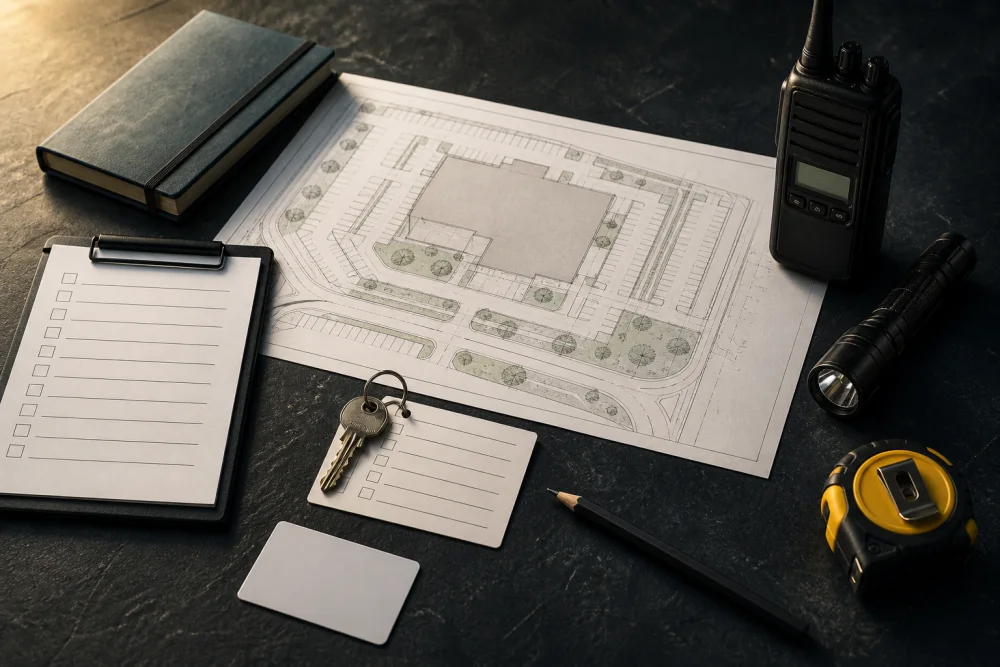
Identify the document and the site
Put the property name, address, post name, effective date, version, approver and emergency address on the first page. Attach a current map that marks the post, entrances, patrol points, restricted areas, emergency equipment and safe routes.
Los Angeles assignments can sit in Downtown reused buildings, industrial districts or port-adjacent facilities. The Port itself contains passenger, cargo, rail and warehouse uses. The orders must identify the actual property instead of relying on a broad site-type label.
Write the shift and handoff
State the days, start and end time, arrival process, uniform, required equipment, key or access-device transfer and open-item handoff. Explain meal and rest relief. Name the person contacted if the next guard is late or absent.
Use one table for regular, weekend, holiday and temporary schedules. Remove old schedules rather than leaving conflicting instructions in the same binder.
List routine duties in operating order
Write opening checks, access tasks, patrols, desk duties, report times and closing checks in the sequence they occur. State the priority if two duties conflict. Use measurable wording such as “check and record the north loading door once each patrol,” not “maintain site security.”
For each duty, identify the record or outcome the buyer expects.
Set access and exception rules
Define accepted credentials, guest and vendor approval, deliveries, after-hours workers, keys, cards and lockouts. State who can approve an exception and what information is recorded. Include a backup contact when the primary person is unavailable.
Keep leasing, cargo, construction-safety, HR and legal decisions with the responsible business team unless a narrow, approved guard task is written.
Build patrol and report requirements together
Mark the route and checkpoint purpose. State the visit or round frequency, acceptable variation, proof and treatment of an interrupted or missed round. Then define immediate notices, daily activity reports and incident reports.
A useful report records time, location, observation, action, person notified and follow-up. Ask for an anonymized sample before award.
Separate emergencies from routine escalation
List 911 conditions, fire or life-safety directions, management contacts and the information needed for an emergency call. Provide the exact property address and access instructions. State the guard’s limits while waiting for responders.
California Fire Code section 901.7 shows why an authority-directed fire watch should not appear as a one-line extra in general post orders.
Record prohibited duties and revision control
Name actions the guard may not take, including unapproved searches, operational approvals or leaving a continuous post. Identify who may change the orders, how guards receive revisions and where obsolete versions are removed.
Require a site orientation and signed acknowledgment. California’s general training floor does not replace preparation for this property.
Use the checklist in the proposal and launch review
Attach the draft orders to the request for proposal. Ask bidders to identify assumptions or duties they cannot perform as written. Finalize the document before the first shift and schedule an early review after real site conditions have been observed.
Use the company worksheet and cost guide against the same scope. Then Get a Quote.
Frequently asked questions
Who should write security post orders?
The buyer and provider should develop them together. The buyer owns site policy and contacts; the provider contributes operating and staffing detail.
How long should post orders be?
Long enough to remove material guesswork, but organized for use during a shift. Clear maps, tables and numbered duties are often more useful than repeated prose.
When should post orders be revised?
Revise them when the property, posts, hours, access, patrol route, contacts, technology, emergency plan or required reports materially change.